The answer
Why do I look better in the mirror than in photos?
A mirror shows you a face you have seen thousands of times, flipped, moving, lit from the front, and arranged the moment you looked. A phone shows you an unflipped face you barely know, frozen at one two-hundredth of a second, taken at arm's length, which is close enough that whatever is nearest the lens is rendered largest. Neither is the truth. The gap between them is mostly distance, lens and light, and all three are free to fix.
What answers it
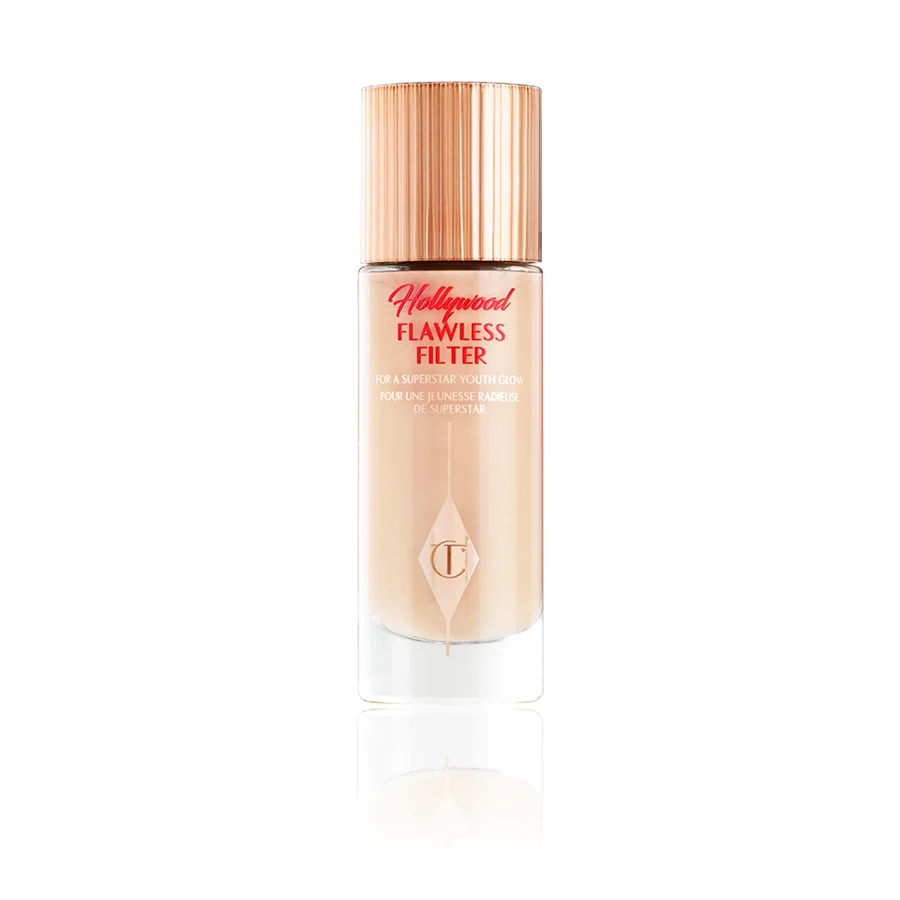 Charlotte TilburyHollywood Flawless FilterFlash is a hard light fired straight at a face, and hard light finds texture. A blurring filter softens what the flash is picking out — it is the one product on this page aimed at the mechanism rather than at you.Buy on Amazon
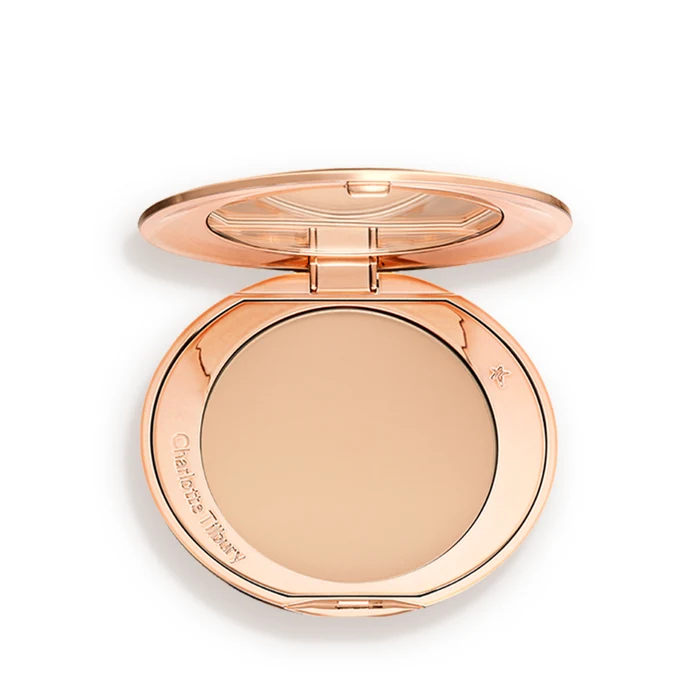 Charlotte TilburyAirbrush Flawless Finish setting powderThe specific photograph problem: a camera flash reflects off oil and returns it as a white patch. Powder scatters that reflection. This is why people look shiny in photographs and not in the room.Buy on Amazon
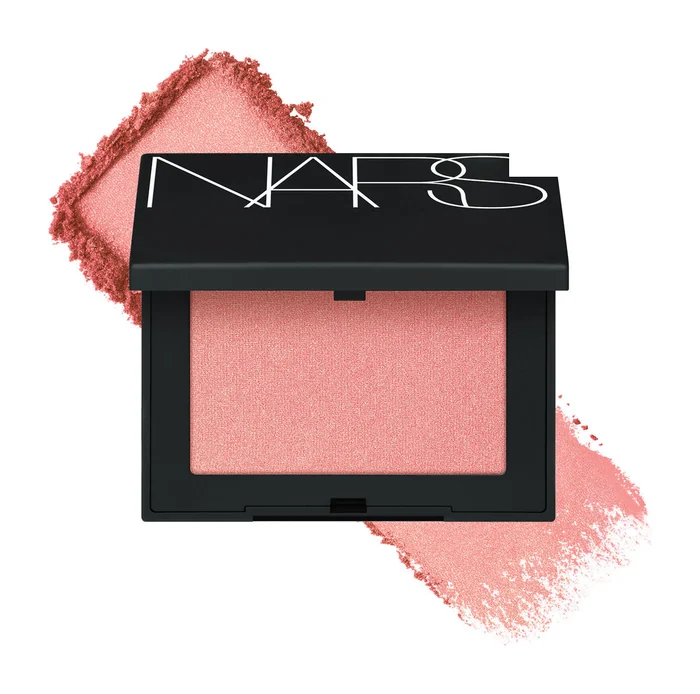 NARSPowder blush in OrgasmDirect light flattens a face and drains colour out of it, which is a large part of why a photo can look ill when the mirror did not. Colour on the cheek is the fastest correction there is.Buy on Amazon
 BenefitThe POREfessional face primerFor skin that photographs textured under a hard light. It smooths the surface makeup sits on rather than covering anything, so it works on the same problem the flash creates.Buy on Amazon
Prices live on Amazon, where they change hourly — so we never quote one. Every product here is a brand we would name out loud.
The face in the mirror is not your face
It is your face reversed, and you have been looking at it every day of your life. Everyone's face is slightly asymmetric, so the flipped version and the real version are genuinely two different arrangements — and you are fluent in one of them. In the experiment that established this, people shown both preferred the mirror version of themselves while their friends preferred the photograph — exactly what familiarity predicts, and the reason it is worth knowing rather than arguing with. Your friends are not being kind. They are seeing the face they know.
Arm's length is the problem, and it is not the lens
This is geometry rather than opinion, and the usual explanation gets the cause wrong. It is not that the front camera is wide — it is that it is close. At arm's length your nose is perhaps a tenth nearer the lens than your ears, and that ratio is what decides relative size, so the nose is rendered larger and the ears smaller. Move to a few paces away and the same ratio becomes negligible, which is why portrait photographers stand back. A longer lens does not fix it on its own; what it does is let you stand back and still fill the frame. So: step away, then zoom or crop to recover the framing. The distance is doing the work.
One two-hundredth of a second is not a likeness
A mirror gives you motion, and a face in motion is read as a whole. A photograph takes one instant, chosen by whoever pressed the button, and that instant can land mid-blink, mid-word, or mid-expression. You have also never seen your own face at rest without knowing you were being watched — the moment you look in a mirror, you arrange it. The camera catches the version that was not arranged.
Bathroom light is designed to flatter and overhead light is not
Most mirrors are lit from the front and slightly above, which is close to what a photographer would set up. Overhead light — ceiling spots, midday sun — drops shadows into the eye sockets and under the nose and chin. A camera flash does the opposite and is just as unkind: it is a hard light fired from the front, so it flattens the face, finds every bit of texture, and bounces white off any oil. Turn to face a window and both problems mostly resolve.
What to actually do about it
Put distance between you and the lens and zoom in. Turn your face slightly rather than squaring it to the camera, and put your chin forward and slightly down — not up. Find the light and face it. And if you want to see what other people see when they look at the photograph, mirror it in your phone's editor: the same picture, flipped, usually looks like the person you recognise. Nothing about the face changed. Only its familiarity did.
Questions
- Which one is the real me — the mirror or the photo?
- Neither, strictly. The mirror is reversed; the photograph is taken through a lens with its own distortion, at one instant, under whatever light was there. Other people see you moving, in three dimensions, from a few feet away — which is closer to the mirror than to the phone.
- Why do I look different in the front camera and the back camera?
- Partly the lenses, but mostly how you hold them. A selfie is taken at arm's length and a photo someone else takes is not, and that difference in distance changes facial proportions far more than the lens does. The rear camera helps because it is longer, so it can be used from several paces away and still fill the frame — held at the same arm's length it would show the same effect.
- Does the front camera flip my face?
- Most phones show you a mirrored preview and then save the unflipped image, which is why the result can feel like a stranger even though nothing moved. Some phones have a setting to save the mirrored version instead.
- Is there makeup that photographs better?
- Some products address what a camera specifically does — powder stops flash bouncing off oil, blush puts back the colour a direct light drains. But the biggest improvements on this page cost nothing: move back, zoom in, and turn towards the light.
Your turn
What should we dress next?
An occasion you cannot find anything for, or a product you want us to look at properly.